
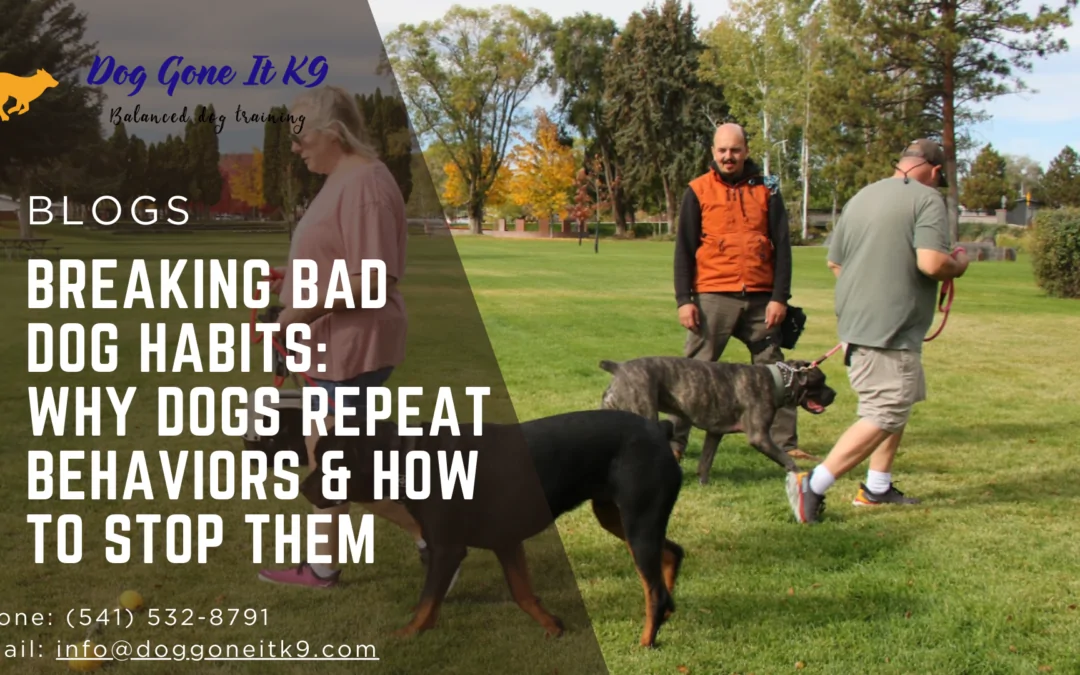
Every dog has habits, some are adorable, and others… not so much. Whether your dog jumps on guests, steals food, barks nonstop, or pulls you down the street, these behaviors didn’t develop overnight. Dogs repeat actions that work for them, and without proper guidance, even small habits can turn into long-term challenges.
The good news? Bad habits can be broken, and good ones can be built. At Dog Gone It K9 LLC, we help families understand not just what their dog is doing, but why they do it – so you can make lasting changes rooted in calm, consistent training.
Below, we break down how habits form, how to interrupt unwanted behavior, and the science behind why consistency matters. Each section also includes a quick FAQ to help you troubleshoot at home.
How Habits Form in Dogs
Dogs learn through patterns. When a behavior consistently leads to a reward: attention, food, freedom, or even just relief, they’re likely to repeat it. Many “bad” habits start completely by accident. For example:
- A dog jumps on you → You pet them → They think jumping = affection.
- A dog barks at the window → The stranger goes away → They think barking made the threat disappear.
- A dog pulls hard on the leash → You move forward → They think pulling = exploration.
Behaviors become habits when your dog receives reinforcement, even if you didn’t intend to reward it.
The key is understanding that dogs aren’t trying to be stubborn. They’re simply doing what has worked for them in the past.
“Why does my dog keep doing the same bad thing even when I correct them?”
Because the reward outweighs the correction. If a behavior results in excitement, attention, or success, even occasionally, it becomes reinforced. To break the cycle, you must remove accidental rewards and replace them with structure and calm reinforcement.
The Power of Consistency and Timing
Consistency is the backbone of dog training. If one person ignores a behavior, another corrects it, and another laughs at it, your dog gets mixed messages. This leads to confusion, and confusion leads to repeated bad habits.
Timing also plays a massive role. Dogs learn in the moment. If you correct a behavior even five seconds too late, your dog won’t understand what the correction was for. Same goes for rewards: if you reward after the moment of good behavior has passed, your dog may associate the treat with something totally unrelated.
Good training = consistent rules + split-second timing.
What consistency looks like:
- The same cue words from everyone
- The same rules across the household
- The same expectations every day
- Immediate feedback (good or bad)
“How fast should I correct or reward my dog?”
Within 1–2 seconds. Dogs connect cause and effect almost instantly. If your timing is off, the lesson is lost.
Interrupting vs. Redirecting Behavior
Stopping bad behavior isn’t just about saying “no.” It’s about breaking the dog’s focus and then giving them a behavior you prefer. Interrupting simply halts the moment; redirecting gives your dog a new job.
Interrupting
Quickly snaps your dog out of an unwanted behavior. Examples:
- Clap your hands
- Use a verbal interrupter (“Ah-ah!”)
- Tap the leash
This stops the behavior temporarily but doesn’t teach a replacement.
Redirecting
Shows your dog what to do instead. Examples:
- Dog jumps → Ask for “sit”
- Dog barks → Redirect to “place”
- Dog chews furniture → Offer a chew toy
Interrupt, then redirect. That’s the formula.
“Should I punish my dog when they do something wrong?”
Punishment alone doesn’t teach the correct behavior—it only shuts the behavior down temporarily. Redirection + positive reinforcement builds long-term habits and a calmer dog.
Setting Clear Household Rules
Dogs thrive when the rules are predictable. When expectations randomly change, dogs become confused and anxious and this often triggers unwanted behaviors.
Examples of clear household rules:
- No jumping on guests
- No rushing out the door
- No begging at the table
- Must sit before going outside
- Must wait calmly before being released from the crate
If everyone in the home follows the same rules, your dog forms good habits much faster.
Pro tip:
Post rules on the fridge or group chat so everyone stays consistent.
“How long does it take for a dog to learn new rules?”
It depends on the dog and the consistency of the household. Many dogs begin improving within 1–2 weeks, but fully breaking old habits can take 30–60 days of solid structure.
Rewarding Calm, Not Chaos
Most dogs are accidentally rewarded for hyper behavior. We pet them when they jump, talk to them when they demand attention, or release them from excitement instead of calmness.
Calm behavior should ALWAYS be rewarded more than excited behavior.
Ways to reinforce calm:
- Reward your dog for lying quietly
- Praise slow approaches rather than jumping
- Only pet when all four paws are on the floor
- Interrupt excitement before it becomes chaos
- Teach your dog a “place” or “settle” command
When calmness becomes the most rewarding state of mind, bad behaviors naturally fade away.
“My dog only listens when treats are involved. What should I do?”
Phase rewards gradually. Start with treats, move to praise or play, and eventually reward with freedom and permission (“go sniff,” “go play”). Dogs shouldn’t obey just for food, they should obey because calm behavior pays off in more meaningful ways.
Dogs don’t repeat bad habits because they’re “bad dogs.” They’re simply creatures of cause and effect, patterns, and reinforcement. When you understand how behaviors form and how to interrupt, redirect, and reward in the right way, you can create a more peaceful, cooperative relationship with your dog.
With consistency, structure, and positive reinforcement of calm behavior, you’ll start seeing big changes. And if you ever feel stuck, Dog Gone It K9 LLC is here to help guide you toward a happier, better-behaved dog. Contact us today!